Wednesday, May 18, 2011
Everything Must Go
Nick Halsey loses his job. He goes home to find that his wife has thrown all of his stuff on the lawn, changed the locks and security codes. His company car gets repossessed. His wife puts a hold on their joint account - rendering his credit and debit cards useless – and cuts his cellphone. He has no place to go, no money, and no way to move his possessions, which he has to do within five days according to city law or go to jail. You could say he's having a bad day. And this is where we find ourselves in Everything Must Go.
It's a great set up. He's down. He's got nothing. He's faced with the necessity to make decisions about his life and himself. He's a recovering alcoholic who has lapsed, he's never without a beer. He was let go from his job because they can get someone younger and cheaper, and, of course, his history of needing time off for treatment and counseling probably didn't help matters. And while he has lapsed, his wife, who apparently is also a recovering alcoholic, hasn't.
In order to gain the five days to keep his stuff on the lawn, he has to call it a yard sale. He hires a local kid, Kenny, whose mother is a nurse taking care of an elderly woman nearby leaving him by himself most of the time, to make signs and watch his stuff. And at first Nick isn't interested in actually selling his stuff, as he hopes to work things out with his wife before the five days are up. Nick and Kenny become friends, with Nick teaching Kenny about sales. Nick also befriends Samantha, the pregnant woman who has just moved in across the street. She has relocated there for her husband's job, he has not yet joined her there.
I have to praise Will Ferrell's performance as Nick. Where Ferrell normally plays these sort of broad, over-the-top characters, here he plays the character with an honest subtlety. He never tries to draw attention to the character or his plight. Think how easy it'd be to play it as 'hey everybody, look, I'm living on my lawn!' Especially for someone like Will Ferrell. He also doesn't play him as a total schlub loser who just gives up. He's a person who doesn't know what to do – hope things work out or just let go?
Where I think the movie falters is the self-realizations just don't seem to read. Nick watches old home movies and sees his dad, always with a beer in hand, just like him. Throughout the movie he suggests that he didn't like his father and that he was a drunk. So you'd think that maybe he'd watch these movies, see this, and, at least, start looking at himself. But he doesn't. The next morning, he's got the beer in hand just like his old man. And this is a movie about self-exploration and realization, so when moments like this pass and nothing happens....it's a missed opportunity. And at the end when he finally drinks coffee instead of beer and decides to sell everything, clean up and let go it lacks the clear, definable moment where he decides to do that. He finds out his wife has been staying with his AA sponsor and... that's it. It's a let down because you're connected with the character but miss out on this important moment.
I also felt that the outcome of Samantha's relationship with her husband was a bit confusing. Nick asks why he hasn't joined her yet and suggests that he's stayed behind because he doesn't want to be a father, and as a successful young businessman he is probably seeing someone behind her back. She tells Nick that she's called him and told him she's leaving him. He finally shows up the next day but she appears to greet him warmly, not like someone who has decided their relationship is through. It left me going 'wait? What?'
The movie is enjoyable and funny. Yes, funny. Not hilarious. Don't expect to bust a gut laughing. But there are laughs. Will Ferrell gives a performance that makes you wish he did more films like this. And I do like the relationship between Nick and Kenny, it's endearing. A good movie.
3 out of 5
Thursday, November 11, 2010
The Girl Who Kicked The Hornet's Nest
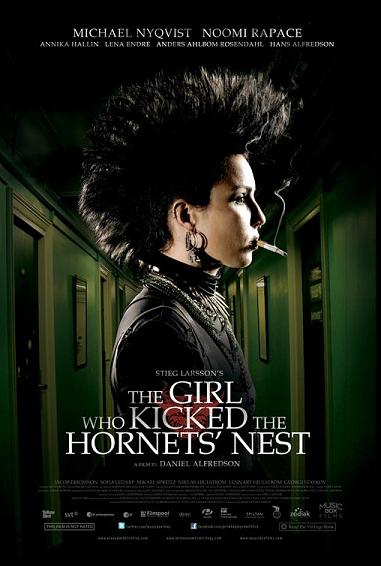
The Girl Who Kicked The Hornet's Nest is the third in the series of novels and films begun with The Girl With The Dragon Tattoo (reviewed previouly). As with the first film, I came into this intrigued by the almost universal praise I'd heard for the film, and series as a whole. I caught up by watching the second film, The Girl Who Played With Fire, first though. Which is good, otherwise I would have been very confused as these two seem more like one story broken into two parts, so Fire directly leads into Hornet's Nest.
On a whole, I think this is a better film than Dragon Tattoo, mostly because it is nowhere near as slow to get going. Unfortunately it seems to still suffer from some rather sloppy storytelling, which is something that bothered me about the first film. In this film we have a character who was introduced in Fire; he serves no purpose, and brings nothing, to this story. But, because his arc was not closed at the end of that one, he shows up a few times throughout this one, to remind us he exists, before they have to add 10-15 minutes to the end of the movie, after the conflict has been resolved, to take care of him. A similar problem that Dragon Tattoo had.
I like the courtroom drama aspect of this film more than the crime/investigation stories of the previous two. For one thing, we've had this central character, Lisbeth Salander, who we haven't gotten to know much and finally, now, we get to actually focus on, and learn about, her. In the first one, we're introduced to her and she's interesting and complicated but we don't end up learning, or knowing, much about her. In the second, she becomes the subject of a conspiracy, but still, we don't learn much about her, except her father is an evil man. It takes until this third film for us to actually get insight into her.
It feels as though it's inefficient storytelling. One of the things that comes to play here, at long last, is one of the problems I had with the beginning of the first film – a subplot between Lisbeth and her guardian. Was that purposefully set up then for use now? Or is it just taking advantage of something that was already there? If it was a set up, why then and there, at the beginning of the first film when it has no bearing on that story? Why slow down the first film solely for the purposes of this one? If it's just taking advantage of something that was there, well, why was it there in the first place? There has to be a better way of giving us the information needed. You can hint at it in the first film then flesh it out later in the second and/or third when it actually has some meaning to the story.
I also have a problem with just believing this story, no matter how much I liked it. In order to keep Lisbeth from talking about her father, a Russian defector protected by a forgotten underground group (yeah, the government just happened to forget about it, how convenient), this group sends her, twelve years-old at the time, to a mental institution headed by a corrupt doctor involved with said group. They torture her and have her declared unfit, thus why, as an adult, she has a legal guardian. I have a problem with this because it would seem to me that, in order to keep someone quiet, a corrupt group would just have that person killed. It's in their power, they kill other people, and they're not good people who would seem to have a problem with killing a twelve year-old girl. A conspiracy seems much too complicated, just kill them and be done with it. So everything that ends up happening feels like convenient twists, turns and complications merely for the sake of twists, turns and complications rather than what makes sense for the story and characters. It's as though a bunch of ideas were tossed in a bowl and whenever something was needed, one was picked at random.
It's unfortunate because it is good, I don't want that to get lost in here. If I could walk away from any of these films without thinking 'there just has to be a better way to do this,' they'd be closer to great, and that's what's so frustrating. But this messy, inefficient story keeps it firmly in the 'good' category - it has all the right parts (maybe a few too many), they're just not used properly. Not having read the novels, I can't say if it's a source material problem, but it would seem as though it must be. The only thing that I can't argue with is Noomi Rapace's performance as Lisbeth. It's outstanding. If for no other reason, watch the film, and the whole series, for that.
3 out of 5
Tuesday, October 12, 2010
The Social Network
You may ask yourself “why would I want to see a Facebook movie?” The answer is that it's so much more than a movie about Facebook. Is it an accurate depiction of the founding of Facebook? Undoubtedly not. Does it matter? Absolutely not. The film is like a perfect storm of great parts coming together.
First, there's the script written by Aaron Sorkin. In actuality, the script may be the star of the film. Not only does Sorkin cleverly use depositions from two lawsuits against Mark Zuckerberg as a framing device to tell the story, but the dialogue is superb as well. Using the depositions gives a frame of reference for us, and suggests that what we're seeing isn't necessarily what actually happened, as they point out several times. It also gives the events a more personal feeling as we can see how actions affected them, how the characters view them, and what they think of each other. It adds drama that otherwise wouldn't exist. He makes it a very compelling story of ambition, friendship and betrayal.
Mark Zuckerberg is driven to stand out and be exceptional, perfectly set up in the opening scene. He's not great at coming up with ideas, but he has the ability to improve other peoples' ideas and make them great, wonderfully displayed in the following scene. And that creates the problem – if someone has a very basic idea, but someone else is able to fill it out, make it better and make something different and their own out of it, who has the right to it? And with Mark's social awkwardness and ambition, he doesn't understand how to do deal with his friends and their business. And as their business grows, so too do the tensions as they want to take the business different directions.
Then there's David Fincher's direction. I think the most astounding thing is that he was able to get a 160 page script into two hours. The general rule of thumb is that pages equals minutes – a 120 minute movie script should be around 120 pages. But Fincher pushed the actors to spit out the dialogue as fast as they could (the opening scene took 99 takes, and Fincher throughout filming told the actors “Faster!”). But nothing feels rushed. You never feel as though you're being bombarded with information. It's all shown to us very well, you don't miss anything.
Jesse Eisenberg is fantastic as Mark Zuckerberg. He speaks the dialogue so well, it sounds natural (when, in fact, no one talks like that). He also plays Zuckerberg with sincerity – he honestly does not see what the problems that people have with him are. He believes that he's done what is right and proper. He doesn't just play him as someone who is petty and looking to screw people over. And the character could easily come off that way. It keeps the character very human and strangely sympathetic.
I also quite enjoyed Jeff Cronenweth's cinematography. Like he did with Fincher's Fight Club, he largely uses natural light. He lets the location bathe the scene in unusual colors, making very striking and beautiful images. I thought the electronic score by Trent Reznor and Atticus Ross worked very well.
There is no doubt that this is an early favorite for some Oscar considerations. They'll be well deserved. It's an extremely well-crafted, put together, interesting, funny movie. There's quite a lot of humor here to break up the dramatic tension. And it's interesting to watch the relationships between the characters change and evolve as the story moves along, especially when you know where they end up – finding out how they get there is the fun and intriguing thing. There's so much more to this than just being about Facebook. And with a great script, great direction, and a great performance, how can you go wrong?
5 out of 5
Wednesday, August 18, 2010
Scott Pilgrim Vs the World
How to describe Scott Pilgrim vs the World? It's kind of like if someone took a Michael Cera movie, old-school video games, comic books, a Beck CD and thew them in a blender together. And when you put them together, you're not too sure how it'll turn out. The result is weird. But it works. Though, I will admit, it most likely doesn't work for everyone.
It starts with Scott dating a high-school girl named Knives. She's 17, he's 22. Don't worry, they haven't even held hands yet. She's totally smitten with Scott. Scott seems as though he's satisfied having someone who thinks he's completely awesome after his last girlfriend wrecked him a year ago. But then Scott sees a girl in his dreams, then he sees her at the library. At a party he finds out who she is, Ramona, and that she happens to be there. He tries to talk to her, but it doesn't go so well. After that he finds that she delivers orders for Amazon.ca (it takes place in Toronto), so he orders something so she can deliver it. He convinces her to go to the show his band, Sex Bob-omb (Bob-omb is a Super Mario Bros. reference), is playing. At the show is when things start to get weird (this is a relative term) for Scott – they are interrupted and Scott is challenged to a fight by the first of Ramona's evil-exes. Over the course of the next few days (or however long, it doesn't really give a specific time frame) Scott tries to court Ramona, break up with Knives (“But it's hard” Scott replies when his roommate tells him to break up with her), and fight the rest of the evil-exes.
The film exists in a world akin to that of a comic book panel and video games. Sound effects appear on screen (“Knock knock” or “ring”) the same they do in comic books, not in the way they do in the 1960s Batman television show (full-screen “KAPOW!!!!”). It's a fun touch rather than a campy gimmick. Same goes with video game flourishes like power bars, hit combos, level ups, points, etc. And the film does it so naturally, it doesn't feel out of place or take you out of it – it doesn't call attention to the artifice. It actually serves it. That these exes have powers or abilities doesn't seem strange to the characters. When the exes are defeated, they burst into coins – after defeating the first, Scott gets excited and starts picking up the coins, only to be disappointed that it's not enough to cover bus fare. What seems strange is that they want to fight Scott at all.
Perhaps the most impressive aspect of this movie is that with all of the stuff that's on the screen at any given moment, it's not over-indulgent, distracting, or mind-numbing. Because these touches pop up so frequently, you quickly become adjusted to them. And if you're even vaguely familiar with the vocabulary of video games and comics, it's not hard at all. They're a lot of fun, too, and don't get old because they don't continuously repeat the same thing.
And, really, the keyword when talking about this movie is 'fun.' It's a really well-made movie. It's very funny. The story is clever. But the most important thing about it, and what you'll leave thinking, is that it's an extremely fun movie. And it's not a knock on the movie like other movies where it's just ok and you can't really think of anything good to say about it so you say it was fun. It just oozes pure, unadulterated fun. I can't think of a movie I had as much fun watching.
The movie isn't for everyone (what movie is?), but I don't think the audience is as small and niche as people may think. If you don't know about, looking at it can make you just go 'what?' and think it's something for hardcore gamers and comic book readers, specifically, comic book readers who already know and have read this little known comic book. As someone who plays video games casually (more socially, as social drinkers or smokers only drink or smoke when out with others who do), has only read a handful of graphic novels (none of them are any of the books of this series), and only heard about this one a few months ago when I first saw the trailer, I found the movie extremely accessible. Take away all the flash and touches and it's a romantic comedy, a good one. Once people decide to give it a chance, they'll find that out and be greatly rewarded. You'll get over the weirdness.
It's cute, it's fun, it's never dull, it's funny, and just really, really good. It has a good cast (set Michael Cera aside for the anti-Cera crowd) that includes Kieran Culkin, Brandon Routh, and Jason Schwartzman. There's a very good chance you will leave the theater with a smile on your face. Give it a shot.
4 out of 5
Sunday, August 8, 2010
The Girl With The Dragon Tattoo
I've heard a lot of good things about The Girl With The Dragon Tattoo, a Swedish film adaptation of the Swedish novel of the same name. I haven't read the book, whenever I see it I pick it up, read the back and think it doesn't sound like something I'd want to read. It's the story about an investigation about a 40 year old missing girl case and murders. Next year there'll be an American adaptation directed by David Fincher, so this should be right up his alley (check out Zodiac). So I figured I'd check this out.
The film is slow to get going. Part of this is setting up the character of Mikael Blomkvist. A necessary delay. He's a disgraced journalist who has just been convicted of slandering a businessman (he claims he was set up) and will start his jail sentence in six months. He needs to have a reason to take up the case of the missing Harriet Vanger when called upon by her uncle Henrik. The case is 40 years old. He has nothing to lose, so he might as well look into this, he won't be working otherwise as he's been pushed out of his magazine by the scandal.
What's unnecessary is all the time spent on Lisbeth Salander (the girl with the dragon tattoo of the title). She's eccentric. And she has issues. But they spend a lot of time, in the beginning, delaying the actual start of the story with a sidetrack between her and her new parole guardian. He's abusive and likes to take advantage of his power. The episode is, in and of itself, interesting and compelling. In the larger framework of the story, however, it doesn't add anything that couldn't be done in a more subtle fashion. It's supposed to add character to her, but you could just as easily add that depth through hints, mannerisms, etc, and not stop the story dead in its tracks for 10-15 minutes, just as it's starting to get going. Besides, she's supposed to be enigmatic, so she'd be better served without us knowing. And it seems to be revealed, at the end, that she has a previous history of suffering through abuse, so is this extra 10-15 minutes really necessary?
Once the dust settles on that and the story finally starts to get going, it's really good. It's well done. It's shot very well and the actors give good performances, especially Noomi Rapace as Lisbeth. There's family intrigue, as the Vanger family lives on an island accessible only by a single bridge. Harriet disappeared while the bridge was blocked off for 24 hours because of a traffic accident. The whole clan was there for a business meeting, they don't like each other, and many of them are very unsavory, so there's a select group of possible suspects. The cops weren't able to find anything for 40 years.
Lisbeth, who works for a security company, had previously been hired to investigate Mikael, and she is a very skilled computer hacker. Even though her investigation is over, she continues to hack into Mikael's computer. Once he starts working on the case, she comes across a clue that she's able to crack thanks to her photographic memory. She sends him an email which leads him to bring her on board for the case. From there they unravel serial murders with religious themes, which it seems Harriet seemed to be looking into and maybe got too close to.
The twists and turns are well done and build suspense. It keeps you on the edge of your seat. Then they solve the murders, but not the disappearance of Harriet. When the murders are solved, you feel the resolution and are thus ready for the movie to be over, but it has to continue on further. So this makes the end feel as though it drags on and on. Even when they figure out what happened to Harriet, they drag it on even more.
The original Swedish title translates to Men Who Hate Women and the movie can tend to beat you over the head with that theme, without really saying anything about violence against women. It could use more subtlety. Is there a woman in this movie who hasn't been abused by a man?
In between the slow start and dragging end, this is a very good, interesting, suspenseful movie. Lisbeth is an intriguing character. With some trimming, this could be a much better movie. But I still don't know if the book is something I'd want to read.
3 out of 5
Saturday, July 31, 2010
Inception
Inception is a pet project of Chris Nolan's. He first came up with the idea when he was 16 year old. He's been working on the script for the past 10 years. This is his movie. It's his first wholly original work since his debut, Following. The script is also the first he's written on his own in the same amount of time.
You can immediately see why this script took him so long to work out. At the heart of the movie, you have three time lines going simultaneously. Also, there are so many details to keep track of, if you think it's easy to get lost while watching it, think of how easy it would be to get lost while writing it, when all those details are just ideas floating in your mind and not set anywhere. Nolan did a masterful job of setting everything down.
With this level of complexity, it'd be easy for the story, plot and characters to get muddy, confused, or lost. The story and plot are clear (in the sense that you understand the big picture of what's going on as the little details unravel) – Cobb (Leonadro DiCaprio) has to plant an idea in the mind of Saito's (Ken Watanabe) business rival. Cobb is an extractor, planting an idea is much more difficult and untried. Cobb assembles a team to plan their attack, in the same manner of a heist movie (using that set up helps immensely in making the movie accessible and no doubt helped Nolan). And the characters are well defined, they have distinct roles and personalities.
One of the more impressive aspects of the movie is the way that Nolan makes this whole scenario feel organic and real. It's not a futuristic setting, it has a rather timeless feel to it with nothing suggesting when this is. It's relatively devoid of technology – there's a rather unimpressive looking briefcase which contains the device to connect everyone, with a button and some tubes. Cell phones barely even make an appearance. And there's no expository scene explaining how it's possible to infiltrate another person's dreams by connecting to this machine. By starting the film with a scene showing the team and device in action, we're immediately brought in and believe it without needing these explanations. It's the number one rule of film: show, don't tell. The filmmaker is then free to push on; as long as the characters don't question it, we have no reason to either. It just feels completely natural. And that's damn good storytelling and filmmaking.
I also quite like the special effects. Nolan, as a filmmaker, stresses practical effects over computer-generated, which is really an admirable trait. And we've seen effects like these before, but I don't think ever on the scale Nolan takes it. We've seen buildings fold on themselves, or maybe even a city block, but Nolan folds an entire city onto itself, in just about the only obvious computer-generated effect. Watching that scene is just awe-inspiring. You see it in the trailers and commercials, yet you still find yourself going 'wow.' And we've seen people walk on walls and ceilings in spinning rooms before, but here you have an entire hotel hallway. Watching the actors fight in that long, spinning hallway is mesmerizing. It's incredible to watch. And this was done practically - by building a hallway and spinning it. Very impressive. If we were bombarded by computer-generated effects in this movie, we'd be taken out of the movie because there'd likely be just too much going on.
The film never feels cluttered or overwhelming. At the very least, you always know the filmmaker is in control, knows what he's doing, and has a plan, so you don't feel overwhelmed. And there's a lot going on. Not only is there the planning and planting of the idea, and then the action going on in three levels of dreams, but there's also Cobb's past to deal with. He's haunted by his dead wife, Mal, who is able to infiltrate, and complicate, the dream worlds where their heists take place. She's a part of Cobb's psyche now and he can't control her. In the first scene, where Cobb and his team are trying to extract information from Saito, she sabotages them. So he has to contend with that – he can't know details about the maps that are being created for the dreams because if he knows, she knows, and she'll make hell for them.
Cobb was accused of murdering Mal in the States. He can't go back because of it and is the impetus for him taking this job, as Saito claims he can make a call and have everything taken care of. Cobb didn't murder Mal, but he feels guilt over it. They were stuck in limbo together (in a normal dream, if you die, you wake up, but if you're under sedation, you go into a state of limbo in your psyche until the sedation wears off, and because time is expanded in the dream world and is compounded with each dream-within-a-dream, the time could feel like years), when they woke up, she couldn't believe it was the real world and killed herself. It is because of this guilt that she haunts him.
This is an incredible amount of character and story depth and story complications, that we don't get lost, confused, or overwhelmed is a testament to Nolan's storytelling and filmmaking abilities. This is just, all around, an extremely well-made movie – in technique and story. It's also fascinating, fun, interesting, enjoyable, intense, and will keep you thinking about it well after you've left the theater. What else could you want from a movie?
5 out of 5
Saturday, July 3, 2010
Toy Story 3
To be perfectly honest, I don't know how to start this off. I'll just say that I absolutely loved this movie. It's wonderfully sweet, endearing, cute (in a good way) and touching. It continues the story from the first two movies in an excellent way and brings it to a nice, logical close.
As Andy prepares to go to college, the toys (those who have survived the years of spring cleanings and garage sales) fret their fates – trash or attic. Going to the trash means their death. Going to the attic means they're saved, will stick together, and be there when they are needed again. They've also heard talk of a thing called 'day care,' where other toys have gone.
When they wind up on the street (with the exception of Woody, who Andy has picked to accompany him to college) as a result of a misunderstanding by Andy's mom, they sneak their way into the donation box. Woody, who had tried to save them from the street and the approaching garbage truck, gets stuck in the box as well after trying to convince them to go back to the attic so they will be there when Andy needs them. Woody is totally devoted to Andy (as he was picked to go to college, that's pretty easy for him), the others are more concerned with being played with rather than whose they are.
So they go to day care and it looks like a wonderful place – a constant stream of kids who will never out grow the toys. Woody, unable to convince the others to go back home, leaves and makes his way out of the day care, but is found and taken home by Bonnie, the daughter of one of the employees. He gets played with for the first time in a long time, but can't enjoy it because he just wants to go home. The others still at day care find out that it isn't what it first appeared. It's ruled with a cotton-stuffed iron fist by the bitter Lots-O-Huggin Bear (Lotso for short). Woody finds this out too, then it becomes a prison break as he goes back to rescue them.
This is where the movie breaks away from the first two. It's not just about the toys wanting to be played with (Toy Story being about Woody's fear of being replaced and no longer being played with; Toy Story 2 being about Woody's fear of being broken and no longer being played with; the rest of the toys' concern is being played with), but, now, their destruction and death in a landfill crusher and incinerator.
Heavy stuff for a family film. But Pixar has never been afraid of using unconventional subjects in their family films – The Incredibles is, in essence, a mid-life crisis family drama; Wall-E has almost no dialogue in the first act and paints a picture of a destroyed Earth. That's why Pixar is Pixar, the pinnacle in modern family films – they get that there is more to it than being cute or playing down to what you think kids want or can handle. They make sure there's story, character and depth. They're not just making something to pacify the kids for 90 minutes.
Needless to say, the toys don't die. And they're able to make it back home before Andy goes away. But after going through that ordeal with his friends, Woody gets second thoughts about joining Andy at college. He secretly plants the idea of donating the toys rather than putting them in the attic and leaves an address. Andy thinks it's the day care, but instead it's Bonnie's house. The scene between Andy and Bonnie as he introduces her to the toys is incredibly sweet and just plain wonderful. When he gets to the bottom of the box and finds Woody...the tears will flow. And they are well-earned, genuine, honest tears. That is how much you care about these characters, toys and humans alike.
The voice cast is wonderful, both the returning actors and new ones (Michael Keaton's Ken is just fun). The animation is superb. The story and characters are outstanding. There's lots of fun references to the previous two movies, but never verges into playing on nostalgia. It's not likely you'll find a better family-friendly movie this year (you may find ones you think are better suited for kids, but they won't be as well done overall and enjoyable for all age groups, because there's more to a family than just the kids, isn't there?).
5 out of 5
Subscribe to:
Posts (Atom)